Showing posts with label Travel. Show all posts

Wednesday, November 7, 2018

Wander


We took some time to do some exploring in the small city where we are staying. It began with something really crazy. A drive to the top of one of the mountains that surrounds Surkhet valley where we are staying. 

To the Right is the mountain we drove up. The picture is taken from the roof of the small hotel /hostel we are staying in.

At first the road was they typical bad road that I have come to expect in this rural western Nepali region but as we went further and further up the mountain the road went from typical bad to unbelievably bad to "are we sure this is even meant for a car?" kind of bad. 
When we finally arrived at the summit, I took a minute to get my stomach out of my throat, then proceeded to hike around and see the sights. There were some small shops, and by shops I mean small huts with a few things for sale in them. 

It is a sheer drop from the top of this part of the mountain to the valley floor. When the updrafts are right thrill seeking hang gliders will launch from up here.


A short trail around the top gave us great views of Surkhet Valley which has become the new district and provincial capital so there have been a lot of construction and improvement projects in the works which means the roads are a mess, only short sections are paved.

We explored around the summit area for a while and began the stomach wrenching drive 
back down to the base of the mountain. After a short drive and time for recovery we made to a Hindu temple and worship area. The Deuti Bajai Mandir is the most well known Temple in Surkhet. There is a specially dedicated area for offerings to be made by the foot impressions of Shiva on a rock. 

This Shrine complex to Shiva (inside) is a hub of Hindu worship and religious activity at certain times of the year.

I am not sure what people offer to Shiva but I can tell you the flies really appreciated the offerings.There was one priestess there helping people with their offerings. There were also to women who were washing out one of the shrines. I suppose even the gods need baths 
once in a while. It is interesting that there are candles lit on the side of the shrine symbolic of prayers like Catholics do, and there are bells towards the front for prayers like the Buddhists. It seems that religious activity is religious activity no matter where you go. It is like... pick a religion, light a candle, say the right words and hope someone is listening.

After the Hindu temple we took a stroll through a park which was really a welcome change from the hustle and bustle of the dusty roads and angry horns of vehicles trying to tell you to get out of the way so they could get by. It was about as close to zen as I have come on this trip.

Bulbul Lake is one of the bright spots in this dusty city. It was recently cleaned and renovated and now seems to be a hub for teens to hang out.

We walked around appreciated a few moments of quiet and serenity and headed out for the last part of our excursion. The site we were headed to next is perhaps one of the oldest if not thee oldest touristy site in Surkhet. A little slice of history is what I really love.

This Buddhist temple or perhaps shrine is better is called Kakre Bihar. It is a Hindu-Buddhist Temple Near Birendranagar city where we are staying. Kakre Bihar has a shaped like the seed of a cucumber so it is called Kakre bihar. The Nepali word 
for cucumber is Kakro. The stones of what remains are strewn around the site and you can see by walking around that they are recreating the intricate designs of the broken stones so that each piece can be replicated and replaced.

This temple is believed to be built on 12th century by a famous king who fell in love with the Surkhet Valley. It was destroyed by an earthquake in 1866. Form what I can tell reconstruction this has been a very long process beginning back in the 1980s.

There is a somber beauty that surrounds this place. Almost like walking through a graveyard that even though it looks like it is falling apart you know there is some very old even ancient significance and presence to it. I wonder what it was like 500 years ago to walk the steps to this temple. I wonder how people felt as they approached its imposing size. Perhaps like the Europeans as they approach the Gothic Cathedrals of the middle ages - and still today. 


I suppose this is what religions do. They build massive and impressive structures hoping these structures will impress the God or gods they revere and honor. Religion wants to remind you how small you are compared to the greatness of the deity to which it points. They tell you this is where you have to go to worship your god so that when you get there you can't help but think how small you are when thinking about this god.

What would be really impressive is if one of those gods or God lived as a human so that they knew what it was like to suffer and experience pain and loss rather than just imposing their will all the time. Is that too much to ask? Hmmmm

Just a Meandering Thought...

Tihar

mindy kalingको लागि तस्बिर परिणाम
So, does anyone out there remember the sitcom, "The Office"? You probably remember Kelly and her on again off again relationship with Ryan right? Do you remember the episode where they go and celebrate Diwali and Ryan has the awkward meeting with Kelly's parents, and Michael sings the Diwali song? ...The Office at its best. 

BJ Novak and Mindy Kaling at an event of some kind for people from the office.

Well, I have to confess that at the time that episode aired I really thought that Diwali was something made up for the show. It was not til a while later that I discovered Diwali is an actual celebration in Hinduism. Well it is Diwali festival time here in Nepal and I am experiencing it first hand. Many people know it as Diwali but the hardcore Nepali people will tell you that here in Nepal it is the Tihar Festival.

This festival of lights is typically celebrated between mid-October and mid-November. It is the second biggest festival in Nepal after Dashain. This festival lasts for five days and people worship Lakshmi – the goddess of wealth. 

Businesses will put up strings of lights as a means of inviting Lakshmi to bring wealth and prosperity. These are the outside of buildings lit up in Kathmandu.

All the houses and businesses are cleaned and decorated with the belief that goddess Lakshmi will enter the house that is the cleanest and bring blessing. (Kind of like Santa but without the presents.) People light candles, oil lamps and other lights and the homes and even entire neighborhoods light up like an American Christmas. 

During the five days, crows, dogs and cows are honored for their roles in the life of a Hindu family with vermilion, (the red dot on the forehead) garlands and festive food for what they have done in the lives of their human benefactors. Crows are regarded as the messenger that brought news even during times when there were no postmen and no postal services. 

This dog was very honored on Dog day of Tihar (Tuesday). The red is a symbol of blessing on him for watching over the home or business of his owners.

Dogs are considered obedient animals and they watch over the homes as true guardians. Cows are also a symbol of wealth in Hinduism and they are also the national animal of Nepal. The festival ends with Bhai Tika – brothers’ day, when sisters honor their brothers and pray for a long and healthy life and brothers pray to safeguard the lives of his sisters.

If Nothing else Hindus are very mindful of the members of their family. It is a trend I have noticed in Eastern cultures whether it is Hundu, Buddhist or Muslim. Americans think that have it all figured out except we can't seem to get family dynamics figured out. In the East, family is much more important. I think we could use a little more of that in the West.

Just a Meandering Thought...

Tuesday, November 6, 2018

Surkhet

The final leg of my journey has brought me to the city of Surkhet. Surkhet is a district (the size of a large county which functions more like a state) in the south west of the country. Not terribly close to the majesty of the great Himalayan mountains.

A picture of our small team and a translator at the terminal in Kathmandu airport just before boarding our plane.

Surkhet is a part of the newly formed Karnali Province, (new as in 2015 new) and it is one of its ten districts. lt is located about 600 kilometers west of the national capital Kathmandu and can be accessed by plane in a little over an hour or if by car, eight to ten hours... yeah. 


Birendranagar is the district headquarters of Surkhet it is also the capital of Karnali Province and is the city in which I will be staying for four days. Believe it or not about 99% of this district is considered either tropical or subtropical. Not quite what I normally picture when I picture Nepal.


One of my first sights after leaving the airport


Actually this part of Nepal has more in common with the are of India I traveled to some years ago than any of the picture of Nepal most of us usually see. This province is the least densely populated province in Nepal. (Think of the difference between eastern Massachusetts and Western Massachusetts.)

I am struck by how remote this place feels. It seems like I am so far away from anything familiar and anything I have experienced. At times it feels like I am in a random spot that was cut out of a jungle - it is not the Nepal I was expecting, perhaps it will be the Nepal I need to see or perhaps it is the Nepal that needed to see me.

Monday, November 5, 2018

Kathmandu

Kathmandu is the capital city of the Nation of Nepal. It is in a valley so it is not what you might think of when you think of Nepal. You cannot see snow capped mountains, there are no Alpine Vistas. This time of year it gets pretty warm too. Temps felt like they have been in the 80's during the day. 

A view from the roof of my hotel in Kathmandu at sunset.

In the picture to the right you can see mountains in the background behind which the sun is setting. Those mountains are really just the foot hills of the great Himalayan range. I really wish that the haze in the picture was fog but it is the pollution that hangs in the air here.

My first night in country was pretty restless because even though we were in a major city, the sound of street dogs made it sound like I was in the middle of the woods surrounded my coyotes. 


The picture to the left is the sunrise from the roof of my hotel. Note the same haze

Since sleep was not to be found I wandered to the roof top for a little personal time of reflection and prayer. I think about the people I will be meeting and trying to communicate with. I think about how many have not heard anything like the message that is deep in my heart and soul. I think about how many would listen even if I told them it was the best news they had ever heard.

I am sure I will sleep eventually, for now I will enjoy a few sunrises and sunsets from the roof tops of whatever building I am able to get to...

Just a Meandering Thought...

Sunday, November 4, 2018

Voyage

So our flight left at about 11pm Boston time. They sky was dark as we pulled away from the gate. During the flight most people had their shades draw and I did a lot of sleeping. I happened to notice one or two light spots in the cabin over the course of our flight but when finally landed it was still dark. I spent an entire flight in a seat in a plane. It was dark when I left, it was dark when I arrived. It was dark for all eight hours of my layover, dark when I left there. I did not see light again until began our decent to Katmandu.

Over all the trip involved a lot of sleeping and a couple of movies. The biggest surprise came as we were coming in for a landing. There is a lot of pollution that hangs in the sky here. So much so that many people walk around wearing masks. Apparently the pollution that comes out of the cities in India gets blown by the air currents into the mountains but not over the mountains and so it hangs in the air in lower lying areas like the Kathmandu Valley.
As I walked down stairs into the tarmac and I was greeted by a familiar face. It was a face I have seen though it can take many forms. Shiva is said to live in these mountains and from Shiva's hair springs "Mata Gunga" the goddess Gunga, which flows from the mountains and across the northern plains of India. Shiva is the most revered Hindu god in this part of the Hindu world, and why not, the Himalayan mountains are home for Shiva. For a little more on Shiva click here or here.

Just some Meandering Thoughts...

Thursday, November 1, 2018

Nepal


Related image
Years ago I took a trip to Asia and experienced the breathtaking sights, the cacophony of sounds, the diversity of the land reflected in the faces of the people and the rich cultural heritage of Northern India. I learned so much about the history and traditions of the people of Northern India and about what anchors their beliefs to the land of their ancestors. I discovered things about the people I never would have otherwise learned and I discovered things about myself that I would have never otherwise learned.

In just a few short days I will be returning to that part of the world. To a region close to Northern India. To a land of deeply held traditions and cultural heritage. Nepal is a country that sits on top of the world... so-to-speak.

Nepal rises from as low as 190 feet in tropical Terai, the northern rim of the Gangetic Plain where temperatures can reach up to 110F, to beyond the perpetual snow line where 90 peaks over 7,000 meters including Everest can be found and temperatures can be as cold as anything in the polar regions.The average annual precipitation varies from as little as 6.3 inches in the north of the Himalaya to as much as 216.5 inches on windward slopes.

I go to observe, to listen, to share from my own life and experiences and perhaps to challenge some to think and see beyond themselves and their current circumstances to something greater than themselves. The best way for me to share my story is to first listen to theirs. That will be the first thing I do. 

Listen to the stories that surround you. Listen to the stories of hurt, pain, loss, survival and you will hear stories similar to yours. You may even hear stories that inspire you to do and be more without having to travel to a far off place. Maybe what you hear will inspire you to go to a far off place to inspire others.

Just a Meandering Thought...

Saturday, December 28, 2013

CHRISTMAS REFLECTIONS - Magi

Lets take a look at these wise men who are mentioned in Matthew's edition of the life of Jesus. Only Matthew and Luke give us historical details about the birth of Christ. Matthew chooses to tell us about these strange visitors from the east, Luke chooses to leave that out but instead tell us about shepherds in fields nearby watching their sheep. One of the hints, by the way, that Jesus was not born on December 25th.

We know these men were astrologers of some kind and that Matthew refers to them as Magi. Now, hundreds of years before, there was a nation which grew into a short lived, but large, empire called the Medes. This empire stretched from the Indus River valley in the east (Pakistan today), to Anatolia in the west (Turkey today). This empire was made of of six tribes, one of which was called the tribe of Magi.

photo credit
This tribe was a priestly tribe in the same way that the tribe of Levi was to the Jews or that Druids would were to the Celts. They were very educated having spent a lot of time learning about the natural world, including medicines, herbs and the movements of the cosmos, and how they might foretell impending events on earth. These men were soothsayers, interpreters of dreams, philosophers, naturalists and would have been highly regarded members of society.

Astrology, one of their specialties, was a widely known and used approach to telling ones future. Reading the cosmos was a science to these men. We do not know what brilliant star the Magi saw but whatever it was the message interpreted was compelling.

And of course, as everyone in the ancient world knows, the best astrologers came from the east. If you were going to have some one read the stars for you, you wanted an astrologer from the east, because those westerners don't know what they are talking about.
Credit

This message impelled them to journey hundreds of miles across varied terrain for what what likely several months into the territory of a neighboring empire (which was hardly ever neighborly). They carried supplies for the journey, they carried money so they could resupply along the way, they had animals to carry the supplies and money, they had extra men to help them keep track of all the supplies and the animals carrying the supplies. And of course with all the animals and supplies and men to help with everything they would have drawn some attention to themselves so they would likely have had some armed security to help to protect them on their journey as well as money and supplies for those men too. Not to mention the expensive gifts that were being brought to honor this new born king.

We don't know exactly were they left from but if we were to place them in the center of the region where the Median empire was, that would put them in the middle of modern day Iran just south of the southern tip of the Caspian Sea. IF they left from there (modern day Tehran) and followed the trade routes, their journey was likely around 2,000 miles. That is a long distance to travel to honor someone who is not one of your own people and will not be your king. If you estimate the amount of time it would take to make that journey you could say that the Magi likely saw the star in the east around the same time that the angel appeared to Jesus' parents.

Credit
Keeping all this in mind, I wonder... Why? 
Why the long journey? 
Why Magi? 
Why not wise men from the country Jesus was born in? 
Why not wise men from the Jews?
What is God telling the world by making this announcement to men who don't believe in the Jewish God?
Why not someone that others would believe?

This says something about the way God does things. We can ask why God did not announce to the the Jewish people the arrival of their Messiah; except, he had been speaking to them through the prophets for hundreds of years in the Hebrew Scriptures. In fact when the Eastern wise men arrived and asked where to find this king, the Jewish wise men knew exactly where to look, Bethlehem. 

The Magi traveled upwards of 2,000 miles to meet this newborn King, the Jewish scholars would not travel the six miles from Jerusalem to Bethlehem to even see if it was true. 


Herod was so concerned that this newborn King might take over his rulership and his Kingdom that he ordered all baby boys in and around Bethlehem slaughtered. He did not understand the kind of King that Jesus would be or the kind of Kingdom that he would establish.

I guess what I am saying is that according to Matthew's edition of the the birth of Christ, the wrong kinds of people are hearing about Jesus. What is worse they are taking action. The ones who have the Bible memorized and can quote all kinds of verses to you, they end up being the ones who miss the whole point. Matthew is telling us that God chooses the most unlikely people, the people that most others would overlook. God chooses the J.V. kinds of people, the second stringers, the ones who get ruled out, the ones who sit by themselves at lunch, even those who like country music. God did not announce his arrival to the Roman leaders or the Jewish leaders, but to astrologers who did not even believe in the Jewish God.

What does that say about who should be in your church?

What does that say about how God speaks to us?

What do you think that says about what God things about you?

The God of this story invites people no one else invites... He wants the people most of us don't even consider... this God says that even you are invited into His story... You don't have to have it all figured out to have a spot at His table...

This God invites you with all your questions, and your doubts, and your bad theology, and your bad taste in music (if you like country)...


Just a Meandering Thought...

Friday, August 5, 2011

RISHIKESH

Rishikesh is a holy area along the Ganges River several miles from Hari Dwar. It became famous in the West after the Beetles went there in (‘67?). They met with a guru and stayed in one of the Ashrams here by the river.

A couple make an offering to the River goddess Gunga. They put flowers purchased at a shop owned by one of the Ashrams place them in the jar of water scooped out of the river, then pour both back to the river.

An Ashram is a Hindu Monastery. The place the Beetles visited is no longer in existence, well… it is there but it is a hotel now. When that Guru died people stopped coming to that Ashram and it fell into disrepair until it was purchased by the hotel.

This is a Temple inside an Ashram near the river bank.

If you want to visit an Ashram there is certainly no shortages of them in Rishikesh. Rishikesh has one of the highest concentrations of Ashrams in India. Almost every building here is in some way part of an Ashram or is owned by an Ashram. Some have sprawling complexes where entire families will live, they are not just for meditative monks.

Men and idols under a Bodhi tree, the same tree under which Siddhartha was sitting when he attained enlightenment and became Buddha.

There are also many places in Rishikesh that teach how to read Sanskrit, the holy language for Hindus. All of Hinduism's holy scriptures are written in Sanskrit. It is a dead language but the holy men of Hinduism only read the scriptures in Sanskrit.

A guru reading the Sanskrit scriptures who whoever will sit for a while and listen.

There are many places where I saw very old men sitting by the Ganges and reading the Vedas or the Gitas in what looked like very old books. These men are thought of as very holy men. The two holy locations in the area are Hari Dwar, which I have already written on, and Rishikesh. These two places each have their specialty. Hari Dwar is holy because of the mythological stories about its origin. It is the place where you go to perform holy rituals.

Rishikesh may be the place where people go for Hindu learning, but since it is on the River, thousands of people will come here to wash their sins away in the river.

The area in and around Rishikesh is where the ancient Brahmin priests would go to get away from the world to meditate for long periods of time. It was during the middle of the first millennium b.c. roughly when the Upanishads were written. Today Rishikesh is a center of learning and study and gaining holy knowledge. Hari Dwar is the place do holy rituals, Rishikesh is the place you go to gain holy knowledge. Hence all the Ashrams where you sit under guru and learn the holy scriptures, and all the places where you can learn Sanskrit.

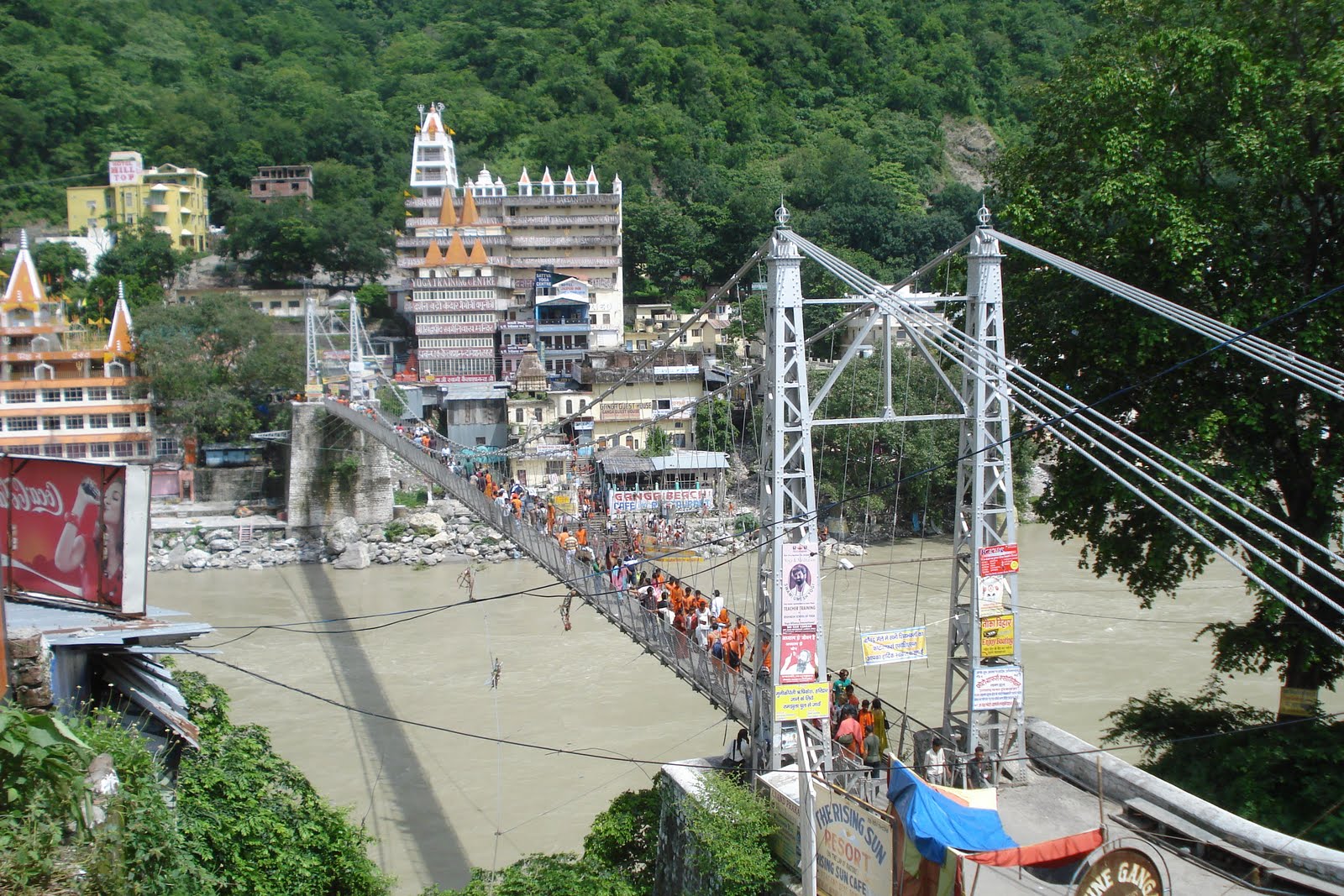
One of the most prominent features of Rishikesh is the huge suspension bridge that spans the entire breadth of the Ganges river. Whenever you see pictures of Rishikesh you will see pictures of the bridge. This bridge is about the width of your average sidewalk. Yet you will have four of five or ten people trying to walk in the same space, and believe it or not while walking across the bridge myself, a motorcycle went right past me.

The entire month of July is the pilgrimage month and the holy pilgrimage color is orange. It has something to do with the color of the sunset and how the color symbolizes the going down into the river and then coming up as a newly washed person.
Just as the color of the sky when the sun is setting and rising. So many people were bathing it was extremely crowded. A lot of people have a lot that they need to cleanse in the their soul. I am not sure they find what they are looking for though. The Hindu scriptures say nothing of absolution. Each of these people will come back and do the same thing next year with no sense of certainty that they are getting what they came here for.

Saturday, July 30, 2011

VILLAGE

On the last day in Pathrie, just before leaving we visited a village where people of the “backward caste” live. Actually, I believe that it is not even accurate to call them backwards caste.

A group of young ladies washing their clothes with water from a well. In the background is one family's home. It is a wood framed hut that is open on three sides and plastic over the top to protect from rain.

The government is trying to change the terminology for the castes. There are four major castes in India; the upper two castes are now called forwards castes, and lower castes are now called backwards castes. Not sure if that really changes the perception at all especially since the government also prohibits discrimination based on caste.

A little boy watches as a group of white people walks through his village. The distended belly is a sign of malnutrition.

All that to say that the people who live in this village are called Dalits. They are below the caste system, also referred to in some places as the untouchables. This particular village is known as a snake charmer village because the men make money by taking cobras to places frequented by people especially like Hari Dwar to charm them before and audience and earn some money. It was not until recently that their homes were made of bricks instead of mud or simple wood framed straw huts.

A man taunts the cobra with the back of his hand. The snake struck a few times but I think it was too small to do anything. This particular snake is new, and in training so none of us white people were allowed to touch it.

The government is trying to help these people by giving them bricks to make more stable homes. The school in Pathrie is given several of the kids in this village a scholarship to attend their school. The teachers say that these kids are some of the brightest in their classes. If it were not for the school in Pathrie these kids would not go to school at all, even the government schools.

This is one of the mud hut homes in the village. Until the government bought bricks this was the most stable structure in the village.

The assistant principal Ajay has developed a great relationship and rapport with villagers. They trust him so they send their kids to his school.

A few boys from the village who are school age. They are fascinated by a digital camera. I take their picture and they love to see themselves on the screen.

The government has even outlawed the catching or killing of many kinds of animals, including snakes, which is how these people typically make their meager living. If they are caught with animals that have been recently trapped they can be fined or arrested. They trust Ajay enough to bring out the snakes for him and for us.

Thursday, July 21, 2011

BIRTHDAY...

I was supposed to go to a school today but there was a mudslide that covered the road so I went instead to another school.
There is an orphanage as part of the ministry of the school. They only have room for 30 kids. Each group of six to ten kids has an adult couple that cares for them. They call them parents, and the place is called a children's "home". This is so that the kids can have something close to a family.
I walked into one of the rooms while the kids were in class as part of a tour I was getting of the facilities and started crying.

I don't know who the kids are,
I don't know their stories,
I could not point them out in a crowd,
or if they were standing in front of me,
but I cried for them.

I think I cried because my time in youth ministry grew a conviction in me that no child or teen should ever be thrown away, figuratively and literally and there are places in the world where both happen.
What does it do to a child or teen to always have in the back of their mind to know that some one cared just enough to not abort them, but not enough to care for them personally.
I know this is not the case for many or even most of the students. But at the same time I have heard enough stories to be able to piece together what their stories could be.
No one should ever have to wonder whether or not they are loved.
To never know the soft caring touch of a loving mother,
to never hear the words I love you, or I am proud of you from a father

Today was my birthday...
No one here knew...
I turned 35 years old...
There was no cake
There was no Ice cream
There were no cards
There was no song
There were no candles
There was nothing wrapped

Only a group of people I have met from different places around the world who happen to be in the same place at the same time.
Nothing that resembled a birthday party.

This time around that is okay.
Some kids smiled today because I said hi,
Some kids giggled when I shook their hand,
Some kids felt smart when teaching me Hindi
They took their picture with me and fought over who could see it on my camera
Their dirty faces beamed with delight today
I looked at dirty faces today, I saw something beautiful
That was my birthday present...

Just a Meandering Thought...

Tuesday, July 5, 2011

GRAVEYARD

On Saturday we drove up and down… but mostly up these very windy roads through very steep mountains, which are actually the foothills of the Himalayas going as high as 10,000 feet here.

One of the many twisty and windy roads on our way into the mountains... ahem... foothills.

In some places the drop offs down the side of the road were at least 1,000 feet… and there are NO guardrails.

As I mentioned in my previous post “OFF” cows and monkeys were common sights, and in the little villages we would pass through men carrying heavy loads was also a common sight. The first place we stopped on our Saturday outing was a British graveyard.

This is a portion of the road we walked to get to the graveyard. They built spaces in the retaining wall for trees to continue to grow rather than cut them down. The root systems gives stability to the soil during the rainy season.

Land is precious in India. Hindu’s do not bury their dead because they believe it defiles the land. Instead they burn dead bodies or simply send them down the holy rivers. In order for the British to get a plot of land where it was okay for them to bury their dead it had to be land no one else wanted or land that was useful for little else. Hence this British Cemetery, which is actually in Landour (part of Musoorie) is on the side of a very steep mountain slope. Most of the soldiers who were buried here died of Malaria around the time of WWI; some, however, were from well before that time.

The picture to the right may give you a small idea as to the slope that we were on. The grave on he left is a more prominent one that was close to the wall and a little easier to get a picture of.

The gate was locked (see pics below) and apparently we were not supposed to be inside but the wall broken down around the side which gave us the opportunity to get a closer look. Dehra dun was a British hill station for many years until the independence in 1947. This brought a strong British cultural influence to the region; it is why we have tea time here at the college.

The stones that you see in these pictures were only about three feet long. Maybe the Brits were a lot shorter in those days, but I think that because of the degree of the slope they simply could not make full length coffins.

British soldiers and officers were stationed in Dehra dun and many officers had homes in the foothills towns like Musoorie where we went for our Saturday excursion. Musoorie started as a place where British soldiers would recover from war wounds and sicknesses but eventually it grew into a community and a popular vacation place for officers. There is also a military school here somewhere though we did not see it. That being said, when British soldiers died, the closest place where they could be buried was here.
A slightly different angle. It is eery to think that the person who was buried here was laid to rest so far from his homeland. He may have living relatives who have never visited his grave or even know that he is here. It was a quiet, beautiful, and lonely place.

This photo to me is a depiction of the Indian culture and the Cross. The culture is closed and and locked to anything outside of Indian culture...

...but the Cross is at work in ways that none of us can really understand. Jesus is already inside the gates. The gates of Hell can not prevail, nor can the gates of culture or politics.

These two pictures give a good illustration of the attitude towards Christianity here. Some are closed to the idea, others think anything is possible. What you focus on will determine what you see.

Just a Meandering Thought...


After the Graveyard we had lunch and then went to the FALLS (the last portion of our day off) which will be in the next post.