Thursday, August 11, 2011

BRICKS

So I went to a pretty remote village. Most of the structures there were straw and/or mud; there were a few that were brick. This again was a village of people who are considered to be outside of the caste system, or Dalits, also known as "untouchables". There were just a couple of structures that had electricity. The government provides bricks to these people to help them build homes that will last through the monsoon season. It is part of the the government's initiative to help these people.
A partially used stack of bricks sits in a vacant area of the village waiting to be used up by the people there building homes.

According to Orthodox Hinduism. These people are not considered Hindu's because they are outside of the caste system. They are below the lowest caste. They cannot participate in any temple worship, or make any offerings to any gods, or even go into a Hindu Temple. Christianity comes along teaching things like '...there is neither slave nor free, Jew nor Gentile...' etc... and it appeals to people like the Dalits who have nothing and live at such a low station in life.

This one room building is the village church. There are bricks on the ground just to the left of the door; these bricks will be used to build a small room on the side for the children.

In this village of about 300 people there is a small temple or shrine made of mud. Inside is the village deity. This is how just about all rural villages in India are; each one has its own shrine to its own deified spirit in addition to the more well known gods like Shiva. Christianity came to the village just a few years ago for the first time, and the people seemed to gravitate towards the teachings of the Bible, and the person of Jesus. When it came time to build a structure as a place for the Christians to gather, they decided to build it with bricks. It was a statement, Jesus is here to stay.

Two children are playing with the dishes we ate off of for lunch. Though it does look like they are arguing right??...

It is an interesting phenomena is the Indian ID card. On the ID card is place where you delcare what religion you are. Buddhist, Christian, Hindu, Muslim or even Sikh, even though that is a sect of Hinduism. The Dalits, as Hindus, get government grants for many things. They can go to school on the government dime, they receive bricks to build homes, they often simply get checks from the Indian government so they can live (India's version of Social Security.) They do what they can to keep people Hindu in order to preserve their ancient heritage and culture.

I am standing outside one of the straw homes in the village. Inside was a sick elderly couple and their grandson. He was taking a break from the mid day heat before going back into the fields to work.

That is of course, as long as the ID card says Hindu, (or Sikh or Buddhist, since Buddhism started in India). If a Dalit becomes either a Christian or a Muslim, he or she is no longer considered outside the caste system and is therefore no longer eligible for government support. So a Dalit actually gives up a lot to walk away from Hinduism. Once a Dalit becomes a Christian he or she is dependent on the Church community for help in times of trouble because most Hindu's refuse to help non-Hindu's.

Children outside their home on beds.

Now in this village there are 20 baptized believers and several others who attend but are not baptized, out of 300 people. The pastor here earns at most the equivalent of $80 per month. He has no formal education, but he loves the people here and that is why the people here will listen to him.

  • The village still gets bricks delivered, for now.
  • The people survive.
  • They somehow get by at way below the poverty line... the Indian poverty line.
  • Their farming does not pay well; it is barely enough to live on.
  • Yet I have not seen as many smiles on faces in Indians as I did that day in that church.
  • It makes me wonder what Jesus gives these people that they don't get somewhere else.
  • Is it real or just a perception?


SATELLITE

On Monday I went to the training center in the City of Seharampur. It is very much a grass roots kind of organization there. They basically offer one year of Bible and Christian education and the students earn a certificate. These students are between the ages of 17 and there was at least one who was in his early 40's.

Students from the Sehrampur Satellite school. Girls, as always, sit in the front and guys in the back.

Most of these students come from villages where there is extremely low income. They just want to know more about God and get something started in their home village. While they attend this school, most of the students live in the first floor of what really is a very big house. The basement of the house has space for their "dorm rooms" as well as a kitchen and common space. The second floor is the home for the pastor and his family.

The rooftop area is open and can be used for a variety of things from drying clothes to just hanging out and drinking tea.

The third floor is just the roof but it has space for hanging out clothes to dry. It is just an open space. The training is done in the church building itself. The students sit in the pews and the teacher, me for three days, stands at the front with a white board. They receive some basic teaching and training so that they can do ministry in their home villages among their own tribe.

There I am during one of the training sessions. My interpreter is standing next to me. He is actually a graduate of the school where I spent most of my time in Derhadun.

Some are here from the city and are just looking for a little extra knowledge to help them understand the Bible more. I feel so inadequate to be in front of these people. I am just a student teaching other students. I don’t even know for sure if what I am saying has any kind of help for these students or if things are getting lost in translation. I taught for almost four hours on Monday. I was expecting to teach for an hour or two each day, but now it seems that I will be going for four hours each day, or until I die, whichever comes first.

This is the view from the roof of the home where I stayed. You can see that just beyond the street in the lower part of the picture, is where there is a portion of dense jungle.

I really did enjoy the teaching but when sweat is dripping down your face and getting into your eye, and then they say ‘oh we need to stop for tea time’ your first reaction is ‘ sweet I could really use a break. Sitting down would be the best thing for me right now.’ Then they bring out the tea and you realize that they made the tea with boiling milk then put the teabag in a metal cup which conducts the heat directly to your fingertips, and you think to yourself, ‘who in their right mind drinks boiling hot tea in a time when the average temperature is in the 90’s with about 90% humidity. Then your brain starts working again and you think, oh yeah, I am in India, this is normal for them...

This is the library in the Satellite facility.

The Satellite school is doing a very difficult but a very valuable work in this part of India. The Church absorbs the cost of the students to go through this program and some after completing the one year program will go on the four year school in Derhadun. The pastor I mentioned in my previous post started here in 1993 and there were Christians present in only three or four villages. Today there are Christians in about 200 villages. This is largely due to the work he has been doing in and around Seharampur…


Monday, August 8, 2011

SEHARAMPUR

I was not in Seharampur for 24 hours and I had experienced a monsoon rain which according to everyone there had not happened with such intensity for as long as they could remember. I stayed with a pastor who also heads up a remote training and education ministry for young adults in the city and surrounding villages. So this pastor turns to me this evening as we were driving to the fruit market to pick up some fresh fruit and vegetables (including my new favorite, fresh mangos) and he says to me, “I think we should get some rain tonight.”

Some of the guys after doing a little clean up in the flooded basement.

Just a side note - I know that people in India have different ways of doing things and I really am all about engaging the culture and embracing the differences. Really I am... but there is one thing that is tough to get used to. I have noticed everywhere I go that men show affection for each other the way that women do in the states. Everywhere I go men are holding hands. You tend to see these kinds of things once in a while in the States, but it usually means something a little different. So when the pastor grabbed my hand and held it for a while as we walked through the market I swallowed my discomfort and told myself that this was India and they just do things differently here. When the pastor holds my hand he is not suggesting anything other than a simple demonstration of friendship.

Here is a little friend who appeared, I guess to avoid the flood waters that inundated his previous home.

Right… we get back to his home and his wife as cooked a wonderful meal, we are almost finished and we hear the rain come. It is loud on the tin and plastic roof. We have some fresh mangos after dinner and it is still raining. We step outside onto a small balcony and it is really raining and really windy out. We have a little chat outside in the wind and the rain, and one of the students runs up and says something with some urgency in his voice. I could not understand what he was saying because it was in Hindi, but the pastor begins to head for the stairs and I started to formulate some possible scenarios in my head.

The view from the rooftop where many household chores.

It turns out that it rained so hard the drainage system got backed up and could not drain all the runoff. It backed up into the basement, which is where the students sleep, and where the guest room is. Yeah, I am in the guest room. I could see water bubbling up through the floor and spilling into the area where the guest room is, which is in the lowest part of the basement, and where does water go?? It follows gravity, to the lowest part of the basement. Oh, and of course my duffle bag with all my stuff is sitting on the floor, in what is was two inches of water.

Storm clouds coming in before Sunset.

For a little extra drama, the door was locked and they could not find the key. Oh and so is the “electronic voltage corrector” was on the floor as well. It takes 220 volts of electricity and makes it 110 volts. If we were to turn that on at the wrong moment we would have been standing in two inches of electrocution.
I pulled my bag out of the water, then got a chair and put the Electronic Voltage Converter on the chair, to avoid any possible accidental frying of myself. I checked through my bag to see how much I was going to have to string up on a clothesline over the course of the night. I was shocked to stick my hand in my bag and discover that everything was dry. Nothing got wet. I could not believe it. Except I did believe because I could see that nothing was wet. Needless to say my first day in Seharampur was a very interesting.

Sunday, August 7, 2011

ALONE

In the week after everyone left Derhadun, I thought it would be great to have quiet around here. Just sitting and reading or writing in my journal or whatever. And have quiet was great for about an hour, after that it really started to feel lonely around the guest house. There was no on to talk to and no one to share stories with. There are a couple of American young ladies around but as music teachers they were often gone giving lessons or at the music professors house. Being alone is great but not for extended periods of time.

So to Adam, Sam, and Matt, my American companions in the guest house for four weeks, just know that your presence was missed around here. And I hope you made it back to your families okay.

ASHRAMS

As part of my tour of Rishikesh, I was able to go into a few Hindu Monasteries. Hindu Monasteries are called Ashrams.

The first two of four main teachings that are most common in the early forms of Hinduism. This is a pillar in the center courtyard of one of the larger Ashrams in Rishikesh.

I was fortunate to have, as my guide, a former Hindu Sadhi or Guru in training. The short version of the story as to why he is no longer a Sadhi, is that while in a transcendental meditative state (this guy practiced T.M.) he had a vision of Jesus calling to him from outside the Ashram. He told his guru about it and his guru got so mad that he kicked him out of the Ashram. With nowhere else to go he decided to look for someone who could tell him about who this man was in his vision. He met an old retired pastor who talked with him about the vision and he found out who Jesus was, so he decided that since Jesus appeared to him in a vision he should follow Jesus instead of the Hindu gods.

This is a small temple to Shiva within a small Ashram by the shore. The Temple opens to the east because that is where the sun rises (so I have been told). Orange is the color of the sky when the sun rises, orange is the color of the flowers offered to Shiva and others, Orange is the color the pilgrims where when they travel to Mata Gunga to cleanse themselves through physical ritual from what has happened to their soul.

Yeah… so this guy, Rakesh is his name, he was my guide. He knows Sanskrit so when he greets monks in Ashrams he greets them in their holy language and they welcome him into these places. And when they ask him his name he will tell them the name he received when he entered the Ashram. When a man becomes a Sadhi, he starts a new life, he becomes a new person (figuratively speaking) therefore, his name changes. When Rakesh gives his Sadhi name, he is welcomed with open arms. And with him as my guide it was quite the experience troding the crowded walkways of Rishikesh.

Pilgrims come to make offerings of various kinds before the statue of Shiva stationed on a platform away from the bank of the Ganges. He watches over the millions of pilgrims who will come in the month of July to the Ganges.

Some of the Ashrams are run by very well known gurus and are very well kept and very clean. These gurus may run several Ashrams all over India. Some are very small and not to well kept. They are usually run by less well known gurus who only live and work in the one location. There was a big controversy here recently because of the exposed corruption of one particular guru, guru Baba.

Hanuman, the monkey god is opening his chest to show Sita and Lord Rama within. They are not in this particular statue but there is a mythological story behind it. This statue is like thirty feet tall, and just inside the gate of another Ashram.

This guy owns an operates something like 20 Ashrams and has several fancy homes and dozens of cars. But as a “holy” man he is supposed to be dedicated to reading the holy scriptures and to poverty. Looks like corruption is not an exclusive condition of religious institutions in the United States
.

Friday, August 5, 2011

RISHIKESH

Rishikesh is a holy area along the Ganges River several miles from Hari Dwar. It became famous in the West after the Beetles went there in (‘67?). They met with a guru and stayed in one of the Ashrams here by the river.

A couple make an offering to the River goddess Gunga. They put flowers purchased at a shop owned by one of the Ashrams place them in the jar of water scooped out of the river, then pour both back to the river.

An Ashram is a Hindu Monastery. The place the Beetles visited is no longer in existence, well… it is there but it is a hotel now. When that Guru died people stopped coming to that Ashram and it fell into disrepair until it was purchased by the hotel.

This is a Temple inside an Ashram near the river bank.

If you want to visit an Ashram there is certainly no shortages of them in Rishikesh. Rishikesh has one of the highest concentrations of Ashrams in India. Almost every building here is in some way part of an Ashram or is owned by an Ashram. Some have sprawling complexes where entire families will live, they are not just for meditative monks.

Men and idols under a Bodhi tree, the same tree under which Siddhartha was sitting when he attained enlightenment and became Buddha.

There are also many places in Rishikesh that teach how to read Sanskrit, the holy language for Hindus. All of Hinduism's holy scriptures are written in Sanskrit. It is a dead language but the holy men of Hinduism only read the scriptures in Sanskrit.

A guru reading the Sanskrit scriptures who whoever will sit for a while and listen.

There are many places where I saw very old men sitting by the Ganges and reading the Vedas or the Gitas in what looked like very old books. These men are thought of as very holy men. The two holy locations in the area are Hari Dwar, which I have already written on, and Rishikesh. These two places each have their specialty. Hari Dwar is holy because of the mythological stories about its origin. It is the place where you go to perform holy rituals.

Rishikesh may be the place where people go for Hindu learning, but since it is on the River, thousands of people will come here to wash their sins away in the river.

The area in and around Rishikesh is where the ancient Brahmin priests would go to get away from the world to meditate for long periods of time. It was during the middle of the first millennium b.c. roughly when the Upanishads were written. Today Rishikesh is a center of learning and study and gaining holy knowledge. Hari Dwar is the place do holy rituals, Rishikesh is the place you go to gain holy knowledge. Hence all the Ashrams where you sit under guru and learn the holy scriptures, and all the places where you can learn Sanskrit.

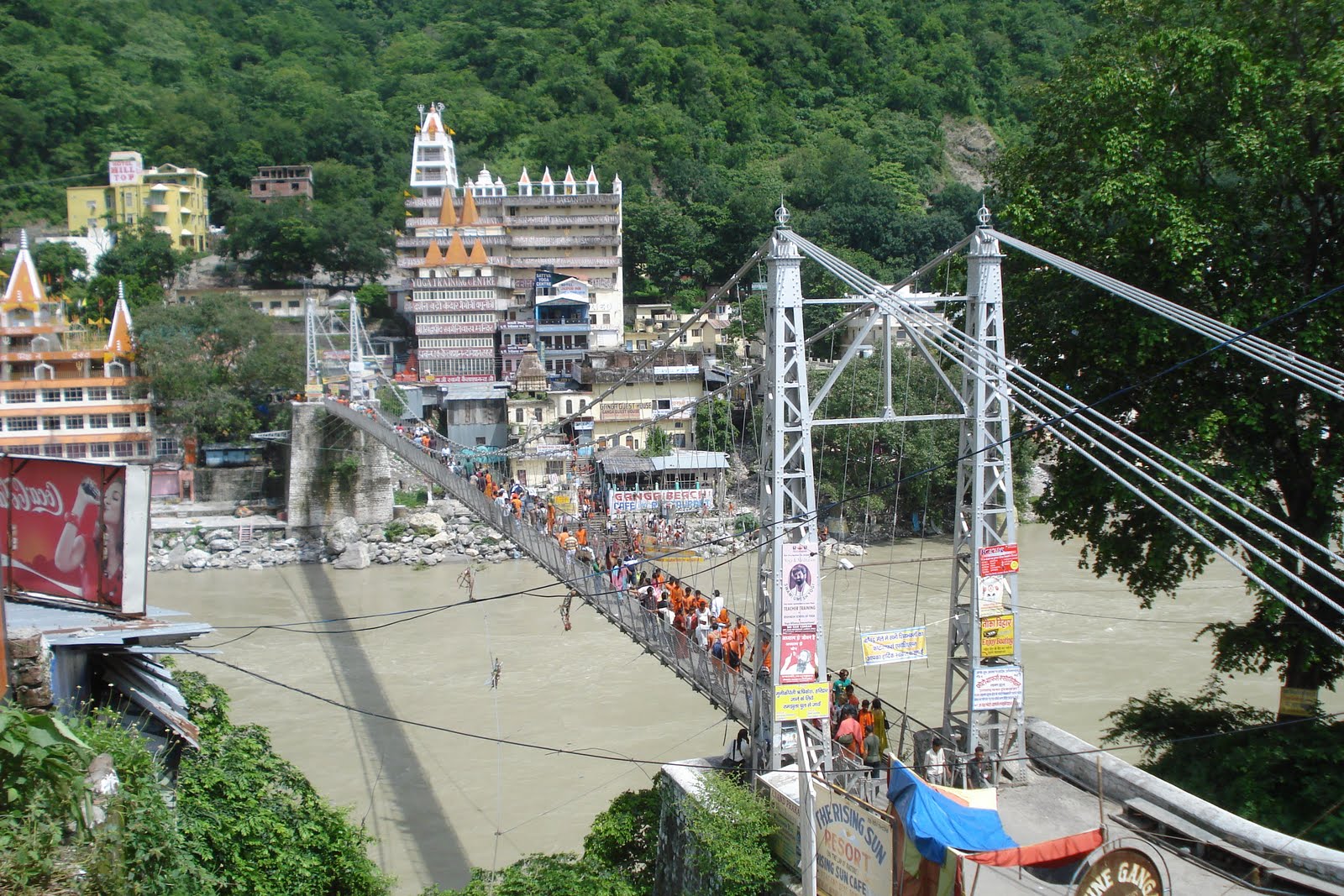
One of the most prominent features of Rishikesh is the huge suspension bridge that spans the entire breadth of the Ganges river. Whenever you see pictures of Rishikesh you will see pictures of the bridge. This bridge is about the width of your average sidewalk. Yet you will have four of five or ten people trying to walk in the same space, and believe it or not while walking across the bridge myself, a motorcycle went right past me.

The entire month of July is the pilgrimage month and the holy pilgrimage color is orange. It has something to do with the color of the sunset and how the color symbolizes the going down into the river and then coming up as a newly washed person.
Just as the color of the sky when the sun is setting and rising. So many people were bathing it was extremely crowded. A lot of people have a lot that they need to cleanse in the their soul. I am not sure they find what they are looking for though. The Hindu scriptures say nothing of absolution. Each of these people will come back and do the same thing next year with no sense of certainty that they are getting what they came here for.

Thursday, August 4, 2011

AJAY

His story begins something like this. Ajay was brought up in a Brahmin family. He was high caste. His family was poor but they knew they were set up well for their next life. Ajay, when he was just five or six years old heard about someone named Jesus whom he had never heard of before. What he heard about Jesus sent him on a long journey of discovery. One problem though; being from a high caste family few people were reluctant to share with him because of the potential consequences. Ajay had several friends over the years who knew about Jesus but not enough to satisfy his curiosity.
Ajay's two kids Appu (boy in blue) Kushi (girl in pink and white) and sister-in-law Kami in the dark blue.

In his early teen years, his mother became very ill. Ajay remembered a story from the Bible where Jesus had prayed for forty days. So Ajay committed to pray for forty days for his mother's recovery. On the fortieth day he went to his mother and asked how she felt. Turns out she felt good. They went to the doctors for a check up and there was no sign of the illness. Some time later, his father became ill, and again he prayed. The Doctors told his father he was dealing with kidney failure and did not have much chance to live more than 35 days. Again after Ajay prayed his father was healed and went on to live a very productive life.

At this point Ajay would say that Jesus was the god for him. As a Brahmin, they were very devoted to the Hindu form of worship. Many people pray to many gods. Jesus seemed to be the god who answered his prayer so Jesus was his god. Several years went by and Ajay continued his search for more understanding of who Jesus is at this point Ajay himself got very sick. It was the same sickness his father had. Ajay developed Jaundice, he had to quit his job and return home. His parents were so poor that there was one point where all they had for sustenance was the water that was left over from cooking rice at his uncle's restaurant.
Ajay and his family. On the left in blue is his wife's sister, next to him his wife, and his two kids are in front. It is uncommon for a family to take care of the wife's family if there is a need. Usually the familial connection is to the husbands family. So inviting his sister-in-law into the home to provide her with an education is uncharacteristic of a Hindu, but very characteristic of a Christian.

Ajay had been so sick for so long that once again he turned to his god, Jesus and prayed for healing. The night he prayed, he had a dream. In the dream he was slapping Jesus in the face. Time after time right hand then left hand. Then he noticed a tear in Jesus’ eye. He stopped and asked Jesus why he was crying. Jesus said, you always come to me and ask me to bring healing. Ajay replied, “yes you are my god, you are the one for me you act when I pray so of course I pray to you.” Jesus said, “But, you only come to me when you need something, you also honor other gods. I want to be the only God for you. So while still dreaming Ajay figured he was going to die anyways so he might as well tell Jesus that he would live for him only until he died. Jesus accepted his word and when Ajay woke up in the morning he was completely healed.

What is so uncommon about Ajay's story is that it is not uncommon. Stories like this are actually quite common. Miraculous healings and visions of Jesus are thought of as normal by most of the people I have talked to over these last weeks. Why is it we do not experience these sorts of things in America, or hear them from Americans???