Showing posts with label Religion. Show all posts

Wednesday, November 7, 2018

Wander


We took some time to do some exploring in the small city where we are staying. It began with something really crazy. A drive to the top of one of the mountains that surrounds Surkhet valley where we are staying. 

To the Right is the mountain we drove up. The picture is taken from the roof of the small hotel /hostel we are staying in.

At first the road was they typical bad road that I have come to expect in this rural western Nepali region but as we went further and further up the mountain the road went from typical bad to unbelievably bad to "are we sure this is even meant for a car?" kind of bad. 
When we finally arrived at the summit, I took a minute to get my stomach out of my throat, then proceeded to hike around and see the sights. There were some small shops, and by shops I mean small huts with a few things for sale in them. 

It is a sheer drop from the top of this part of the mountain to the valley floor. When the updrafts are right thrill seeking hang gliders will launch from up here.


A short trail around the top gave us great views of Surkhet Valley which has become the new district and provincial capital so there have been a lot of construction and improvement projects in the works which means the roads are a mess, only short sections are paved.

We explored around the summit area for a while and began the stomach wrenching drive 
back down to the base of the mountain. After a short drive and time for recovery we made to a Hindu temple and worship area. The Deuti Bajai Mandir is the most well known Temple in Surkhet. There is a specially dedicated area for offerings to be made by the foot impressions of Shiva on a rock. 

This Shrine complex to Shiva (inside) is a hub of Hindu worship and religious activity at certain times of the year.

I am not sure what people offer to Shiva but I can tell you the flies really appreciated the offerings.There was one priestess there helping people with their offerings. There were also to women who were washing out one of the shrines. I suppose even the gods need baths 
once in a while. It is interesting that there are candles lit on the side of the shrine symbolic of prayers like Catholics do, and there are bells towards the front for prayers like the Buddhists. It seems that religious activity is religious activity no matter where you go. It is like... pick a religion, light a candle, say the right words and hope someone is listening.

After the Hindu temple we took a stroll through a park which was really a welcome change from the hustle and bustle of the dusty roads and angry horns of vehicles trying to tell you to get out of the way so they could get by. It was about as close to zen as I have come on this trip.

Bulbul Lake is one of the bright spots in this dusty city. It was recently cleaned and renovated and now seems to be a hub for teens to hang out.

We walked around appreciated a few moments of quiet and serenity and headed out for the last part of our excursion. The site we were headed to next is perhaps one of the oldest if not thee oldest touristy site in Surkhet. A little slice of history is what I really love.

This Buddhist temple or perhaps shrine is better is called Kakre Bihar. It is a Hindu-Buddhist Temple Near Birendranagar city where we are staying. Kakre Bihar has a shaped like the seed of a cucumber so it is called Kakre bihar. The Nepali word 
for cucumber is Kakro. The stones of what remains are strewn around the site and you can see by walking around that they are recreating the intricate designs of the broken stones so that each piece can be replicated and replaced.

This temple is believed to be built on 12th century by a famous king who fell in love with the Surkhet Valley. It was destroyed by an earthquake in 1866. Form what I can tell reconstruction this has been a very long process beginning back in the 1980s.

There is a somber beauty that surrounds this place. Almost like walking through a graveyard that even though it looks like it is falling apart you know there is some very old even ancient significance and presence to it. I wonder what it was like 500 years ago to walk the steps to this temple. I wonder how people felt as they approached its imposing size. Perhaps like the Europeans as they approach the Gothic Cathedrals of the middle ages - and still today. 


I suppose this is what religions do. They build massive and impressive structures hoping these structures will impress the God or gods they revere and honor. Religion wants to remind you how small you are compared to the greatness of the deity to which it points. They tell you this is where you have to go to worship your god so that when you get there you can't help but think how small you are when thinking about this god.

What would be really impressive is if one of those gods or God lived as a human so that they knew what it was like to suffer and experience pain and loss rather than just imposing their will all the time. Is that too much to ask? Hmmmm

Just a Meandering Thought...

Thursday, October 13, 2011

NEXT

Since April, much of my writing has been devoted to India, the people, the culture, the history, the religion, and how all these facets fit together and affect everyday life for the people, even how it affected me while there this summer. For the next few months I am going to spend some time writing and reflecting on those same topics but from an American perspective, Boston in particular. The are certainly some things that are unique to India but there is at least one common thread between the two... people.

I am structuring a class around the impact of modern media on the social consciousness of Americans in general but the people of Boston in particular. I mention this to ask for a favor of you who read my "Meandering Thoughts". I would really like some feedback from you over the next few months, until the end of December, the good the bad and the ugly. If you agree with what I am writing tell me; if you disagree, tell me. If you think I am being a narrow minded, self centered, egotistical, ethnocentric, piously tunnel visioned, whatever... tell me.

My hope is that in the coming months, my reflections and musings on culture, religion, the arts, and personal devotion to a life cause will strike a cord with you somewhere deep in your soul. Besides, the more people I can get "talking" about the things I am thinking about, the better it will look to my supervising professor.
I need to be thought provoking and personally challenging so I will keep the posts short and to the point. I  am looking to touch on the experiences of life that are most common and perhaps bring some refreshing perspective. We shall see.

Ultimately I am looking for the intersection of everyday life, art (in various forms), and the deepest longings of the soul. How does one express the other, where do they overlap and how do we become more complete and globally compassionate people as result. That may be a bit lofty but you have to start somewhere.

Thanks for coming along for the ride...


Tuesday, October 11, 2011

LAST

So this will be my last official post on India even though the memories and the impact continue to rattle my soul. Here are a few closing thoughts on my time in India:

There were some things that I knew about before going to this diverse and complex country. These things included:
  • Huge population and population density
  • Major issues with poverty
  • Very religious people who take pride in their religion
  •  The Ganges river is very important to their religious practices and beliefs.
There were somethings I thought I knew and understood about the Indian people and their culture that turned out to only be partially true. 
  • They like Americans but hate American culture
  • Cricket is the big game in India not soccer (football)
  • People who are "outcastes"were not considered Hindu's until recently 
  • Christianity is a minority religion of about 2.8% of the population. It recently surpassed Islam which is about 2.4%
There were somethings that I was totally wrong about and really had no clue about:
  • Despite being being mostly polytheists and very open and accepting of gods, they really do not like Christianity and Islam. They do like Jesus and Muhammad.
  • Many people think of the Indian people as being warm and welcoming to everybody, but they do not want westerners influencing or changing their culture and traditions. Some will fight over it.
  • There is garbage everywhere because Hindu's believe that everything (including garbage) is Brahman (supreme spiritual entity). So it means nothing to throw Brahman out the window on to Brahman.
  • The beliefs of the Hindus are strongly influenced by their mythology. If you know their mythology you will better understand their customes and beliefs.


Here I am standing on the grounds of Indira Ghandi's grave. This was in a park dedicated to the Ghandi family. Mahatmah Ghandi's grave is located off to my right. This was the last place I stopped before heading to the airport to fly home.


Monday, August 15, 2011

ARRESTED???

Okay, so this kind of trouble was not exactly what I was expecting to happen on a beautiful day beside a river, watching people express their faith in baptism, but trouble is exactly what I witnessed. Our original purpose for traveling to the village that I wrote about in the previous post was because there were eleven people who had become Christians and decided they wanted to be baptized in water. My pastor friend / personal guide asked if I wanted to go see village life and observe a Christian baptism in India. I said sure.

You never know what you will see on these rural roads. Water Buffalo pulling carts, however are very common.

It was a two hour drive out of the small city of Seharampur over paved roads, then to poorly paved roads, to dirt roads, to washed out dirt roads. We pulled off of the road where there was a narrow dirt path that went through some fields of wheat into the village tucked away in a forested area. We entered the church building to see a group of people sitting on the floor smiling as they waited for our arrival.

This is the dirt path leading through fields of wheat and rice to the village just beyond the trees farther ahead.

We spent a brief time there in the church where the pastor gave a talk about water baptism then I walked through the village meeting people and talking with them. Afterwards we drove about a mile to a spot next to a river. It is not the Ganges and I am told it does not flow into the Ganges either so there is no real association with anything Hindu. The people gathered there were just believing Christians who were expressing their faith in water baptism. It is a common ritual among Christians around the world.

I was a special guest in this village so I gave a brief word of greeting to the people gathered there. It is not every day that they see a white person in their humble village. Made it even more humbling for me.

There were 14 people being baptized and one by one they shared their name and the pastor said a prayer put them under the water and then the rest of the church that had gathered sang a song. As we were doing this a group gathered to watch this curious sight. People on motor bikes who were riding up and down the dirt path that meanders along the river stopped to see why people had gathered here.

As the baptisms continued some continued on their way and more gathered.
When the baptisms were finished some young guys who had watched part of the service started asking questions. Obviously I could not understand what they were saying but I thought this might be a good chance for the people in the church to explain what baptism means to those who may not understand what it means.

One lady just before getting baptized.

What I did not understand was that they were looking for a fight. They started getting upset and were trying to intimidate the group because they had participated in a ritual of a foreign religion. Hindu’s don’t mind Jesus, in fact they think he is great.
He is another god for them to add to their 330,000,000 other gods. After a few minutes they started pointing at me and making some gestures that I took to be not good gestures.

This is part of the group that had gathered to question and then intimidate the Christians who had been baptized.

Shortly after, the pastor asked me to get in the vehicle and wait with the engine running. Two other guys who had traveled with us also got in the car. I saw a couple of guys who were not part of the church on cell phones though, again, I could not understand what they were saying or what their gestures meant, but I thought it probably was not good. Soon my friend and guide, the pastor, and the rest of our group got into the vehicle and headed off at a rather rapid rate. We had traveled about a quarter mile when we were passed by a police car traveling in the opposite direction. I did not think much of it at the time but I found out more later. (This is the problem when you do not know the language.)

A man from the village comes up from the waters of baptism. My friend and guide is the guy on the left in the photo.

The men who had caused the disturbance had also called the police claiming that there were Hindus taking Christian baptism because Americans were giving them money to do this… supposedly I was the American who forced them or at least payed them off to take baptism. If we had left five minutes later the police would have showed up and they could have detained us, me in particular. All they need is an allegation they don't need proof.

When we arrived back at the pastor's home in the city, I finally had a chance to really ask what had happened because I was still fuzzy on a lot of it. The way it was explained to me is that there are many elements in India that want India to be purely Hindu. The nickname they give India is Hindustan, which means "land of Hindu". Some of these groups are actually quite violent. The group we encountered were not violent though it was probably because there were more of us than there were of them, so they were not willing to start something they could not finish. The perception of some in India is that people only become Christians because Christians from the west are giving them money. They also assume that all westerners are Christians. So when they see a westerner standing there watching Dalits receive Christian baptism, a western, foreign religious practice, they immediately think that I am giving them money to become Christian. Now, I had never met these people before I have no idea who they are. Because some have a visions of an India that adheres to a pure Hinduism they will pursue whatever means they can to deter outside influences, especially from the West.

Since the incident I have spoken with that pastor, he told me some of the men went to the village to find those who were baptized to intimidate them for of their Christian faith. As far as I know, they have not hurt anyone, but it is not unlikely that this could happen. To top off this whole thing I was in the newspaper the next day. That is right. There was an article in the news paper about an American who was paying Dalits to become Christians. It was all written in Hindi, so I could not read it. But the next day as people were reading the paper, the pastor started getting a lot of phone calls from people who know him asking about what happened. I could not believe that the paper would print that without talking to both sides. But when you have an agenda you will see what you want to see.

That is my story and I am sticking to it...

Thursday, August 11, 2011

BRICKS

So I went to a pretty remote village. Most of the structures there were straw and/or mud; there were a few that were brick. This again was a village of people who are considered to be outside of the caste system, or Dalits, also known as "untouchables". There were just a couple of structures that had electricity. The government provides bricks to these people to help them build homes that will last through the monsoon season. It is part of the the government's initiative to help these people.
A partially used stack of bricks sits in a vacant area of the village waiting to be used up by the people there building homes.

According to Orthodox Hinduism. These people are not considered Hindu's because they are outside of the caste system. They are below the lowest caste. They cannot participate in any temple worship, or make any offerings to any gods, or even go into a Hindu Temple. Christianity comes along teaching things like '...there is neither slave nor free, Jew nor Gentile...' etc... and it appeals to people like the Dalits who have nothing and live at such a low station in life.

This one room building is the village church. There are bricks on the ground just to the left of the door; these bricks will be used to build a small room on the side for the children.

In this village of about 300 people there is a small temple or shrine made of mud. Inside is the village deity. This is how just about all rural villages in India are; each one has its own shrine to its own deified spirit in addition to the more well known gods like Shiva. Christianity came to the village just a few years ago for the first time, and the people seemed to gravitate towards the teachings of the Bible, and the person of Jesus. When it came time to build a structure as a place for the Christians to gather, they decided to build it with bricks. It was a statement, Jesus is here to stay.

Two children are playing with the dishes we ate off of for lunch. Though it does look like they are arguing right??...

It is an interesting phenomena is the Indian ID card. On the ID card is place where you delcare what religion you are. Buddhist, Christian, Hindu, Muslim or even Sikh, even though that is a sect of Hinduism. The Dalits, as Hindus, get government grants for many things. They can go to school on the government dime, they receive bricks to build homes, they often simply get checks from the Indian government so they can live (India's version of Social Security.) They do what they can to keep people Hindu in order to preserve their ancient heritage and culture.

I am standing outside one of the straw homes in the village. Inside was a sick elderly couple and their grandson. He was taking a break from the mid day heat before going back into the fields to work.

That is of course, as long as the ID card says Hindu, (or Sikh or Buddhist, since Buddhism started in India). If a Dalit becomes either a Christian or a Muslim, he or she is no longer considered outside the caste system and is therefore no longer eligible for government support. So a Dalit actually gives up a lot to walk away from Hinduism. Once a Dalit becomes a Christian he or she is dependent on the Church community for help in times of trouble because most Hindu's refuse to help non-Hindu's.

Children outside their home on beds.

Now in this village there are 20 baptized believers and several others who attend but are not baptized, out of 300 people. The pastor here earns at most the equivalent of $80 per month. He has no formal education, but he loves the people here and that is why the people here will listen to him.

  • The village still gets bricks delivered, for now.
  • The people survive.
  • They somehow get by at way below the poverty line... the Indian poverty line.
  • Their farming does not pay well; it is barely enough to live on.
  • Yet I have not seen as many smiles on faces in Indians as I did that day in that church.
  • It makes me wonder what Jesus gives these people that they don't get somewhere else.
  • Is it real or just a perception?


SATELLITE

On Monday I went to the training center in the City of Seharampur. It is very much a grass roots kind of organization there. They basically offer one year of Bible and Christian education and the students earn a certificate. These students are between the ages of 17 and there was at least one who was in his early 40's.

Students from the Sehrampur Satellite school. Girls, as always, sit in the front and guys in the back.

Most of these students come from villages where there is extremely low income. They just want to know more about God and get something started in their home village. While they attend this school, most of the students live in the first floor of what really is a very big house. The basement of the house has space for their "dorm rooms" as well as a kitchen and common space. The second floor is the home for the pastor and his family.

The rooftop area is open and can be used for a variety of things from drying clothes to just hanging out and drinking tea.

The third floor is just the roof but it has space for hanging out clothes to dry. It is just an open space. The training is done in the church building itself. The students sit in the pews and the teacher, me for three days, stands at the front with a white board. They receive some basic teaching and training so that they can do ministry in their home villages among their own tribe.

There I am during one of the training sessions. My interpreter is standing next to me. He is actually a graduate of the school where I spent most of my time in Derhadun.

Some are here from the city and are just looking for a little extra knowledge to help them understand the Bible more. I feel so inadequate to be in front of these people. I am just a student teaching other students. I don’t even know for sure if what I am saying has any kind of help for these students or if things are getting lost in translation. I taught for almost four hours on Monday. I was expecting to teach for an hour or two each day, but now it seems that I will be going for four hours each day, or until I die, whichever comes first.

This is the view from the roof of the home where I stayed. You can see that just beyond the street in the lower part of the picture, is where there is a portion of dense jungle.

I really did enjoy the teaching but when sweat is dripping down your face and getting into your eye, and then they say ‘oh we need to stop for tea time’ your first reaction is ‘ sweet I could really use a break. Sitting down would be the best thing for me right now.’ Then they bring out the tea and you realize that they made the tea with boiling milk then put the teabag in a metal cup which conducts the heat directly to your fingertips, and you think to yourself, ‘who in their right mind drinks boiling hot tea in a time when the average temperature is in the 90’s with about 90% humidity. Then your brain starts working again and you think, oh yeah, I am in India, this is normal for them...

This is the library in the Satellite facility.

The Satellite school is doing a very difficult but a very valuable work in this part of India. The Church absorbs the cost of the students to go through this program and some after completing the one year program will go on the four year school in Derhadun. The pastor I mentioned in my previous post started here in 1993 and there were Christians present in only three or four villages. Today there are Christians in about 200 villages. This is largely due to the work he has been doing in and around Seharampur…


Sunday, August 7, 2011

ASHRAMS

As part of my tour of Rishikesh, I was able to go into a few Hindu Monasteries. Hindu Monasteries are called Ashrams.

The first two of four main teachings that are most common in the early forms of Hinduism. This is a pillar in the center courtyard of one of the larger Ashrams in Rishikesh.

I was fortunate to have, as my guide, a former Hindu Sadhi or Guru in training. The short version of the story as to why he is no longer a Sadhi, is that while in a transcendental meditative state (this guy practiced T.M.) he had a vision of Jesus calling to him from outside the Ashram. He told his guru about it and his guru got so mad that he kicked him out of the Ashram. With nowhere else to go he decided to look for someone who could tell him about who this man was in his vision. He met an old retired pastor who talked with him about the vision and he found out who Jesus was, so he decided that since Jesus appeared to him in a vision he should follow Jesus instead of the Hindu gods.

This is a small temple to Shiva within a small Ashram by the shore. The Temple opens to the east because that is where the sun rises (so I have been told). Orange is the color of the sky when the sun rises, orange is the color of the flowers offered to Shiva and others, Orange is the color the pilgrims where when they travel to Mata Gunga to cleanse themselves through physical ritual from what has happened to their soul.

Yeah… so this guy, Rakesh is his name, he was my guide. He knows Sanskrit so when he greets monks in Ashrams he greets them in their holy language and they welcome him into these places. And when they ask him his name he will tell them the name he received when he entered the Ashram. When a man becomes a Sadhi, he starts a new life, he becomes a new person (figuratively speaking) therefore, his name changes. When Rakesh gives his Sadhi name, he is welcomed with open arms. And with him as my guide it was quite the experience troding the crowded walkways of Rishikesh.

Pilgrims come to make offerings of various kinds before the statue of Shiva stationed on a platform away from the bank of the Ganges. He watches over the millions of pilgrims who will come in the month of July to the Ganges.

Some of the Ashrams are run by very well known gurus and are very well kept and very clean. These gurus may run several Ashrams all over India. Some are very small and not to well kept. They are usually run by less well known gurus who only live and work in the one location. There was a big controversy here recently because of the exposed corruption of one particular guru, guru Baba.

Hanuman, the monkey god is opening his chest to show Sita and Lord Rama within. They are not in this particular statue but there is a mythological story behind it. This statue is like thirty feet tall, and just inside the gate of another Ashram.

This guy owns an operates something like 20 Ashrams and has several fancy homes and dozens of cars. But as a “holy” man he is supposed to be dedicated to reading the holy scriptures and to poverty. Looks like corruption is not an exclusive condition of religious institutions in the United States
.

Friday, August 5, 2011

RISHIKESH

Rishikesh is a holy area along the Ganges River several miles from Hari Dwar. It became famous in the West after the Beetles went there in (‘67?). They met with a guru and stayed in one of the Ashrams here by the river.

A couple make an offering to the River goddess Gunga. They put flowers purchased at a shop owned by one of the Ashrams place them in the jar of water scooped out of the river, then pour both back to the river.

An Ashram is a Hindu Monastery. The place the Beetles visited is no longer in existence, well… it is there but it is a hotel now. When that Guru died people stopped coming to that Ashram and it fell into disrepair until it was purchased by the hotel.

This is a Temple inside an Ashram near the river bank.

If you want to visit an Ashram there is certainly no shortages of them in Rishikesh. Rishikesh has one of the highest concentrations of Ashrams in India. Almost every building here is in some way part of an Ashram or is owned by an Ashram. Some have sprawling complexes where entire families will live, they are not just for meditative monks.

Men and idols under a Bodhi tree, the same tree under which Siddhartha was sitting when he attained enlightenment and became Buddha.

There are also many places in Rishikesh that teach how to read Sanskrit, the holy language for Hindus. All of Hinduism's holy scriptures are written in Sanskrit. It is a dead language but the holy men of Hinduism only read the scriptures in Sanskrit.

A guru reading the Sanskrit scriptures who whoever will sit for a while and listen.

There are many places where I saw very old men sitting by the Ganges and reading the Vedas or the Gitas in what looked like very old books. These men are thought of as very holy men. The two holy locations in the area are Hari Dwar, which I have already written on, and Rishikesh. These two places each have their specialty. Hari Dwar is holy because of the mythological stories about its origin. It is the place where you go to perform holy rituals.

Rishikesh may be the place where people go for Hindu learning, but since it is on the River, thousands of people will come here to wash their sins away in the river.

The area in and around Rishikesh is where the ancient Brahmin priests would go to get away from the world to meditate for long periods of time. It was during the middle of the first millennium b.c. roughly when the Upanishads were written. Today Rishikesh is a center of learning and study and gaining holy knowledge. Hari Dwar is the place do holy rituals, Rishikesh is the place you go to gain holy knowledge. Hence all the Ashrams where you sit under guru and learn the holy scriptures, and all the places where you can learn Sanskrit.

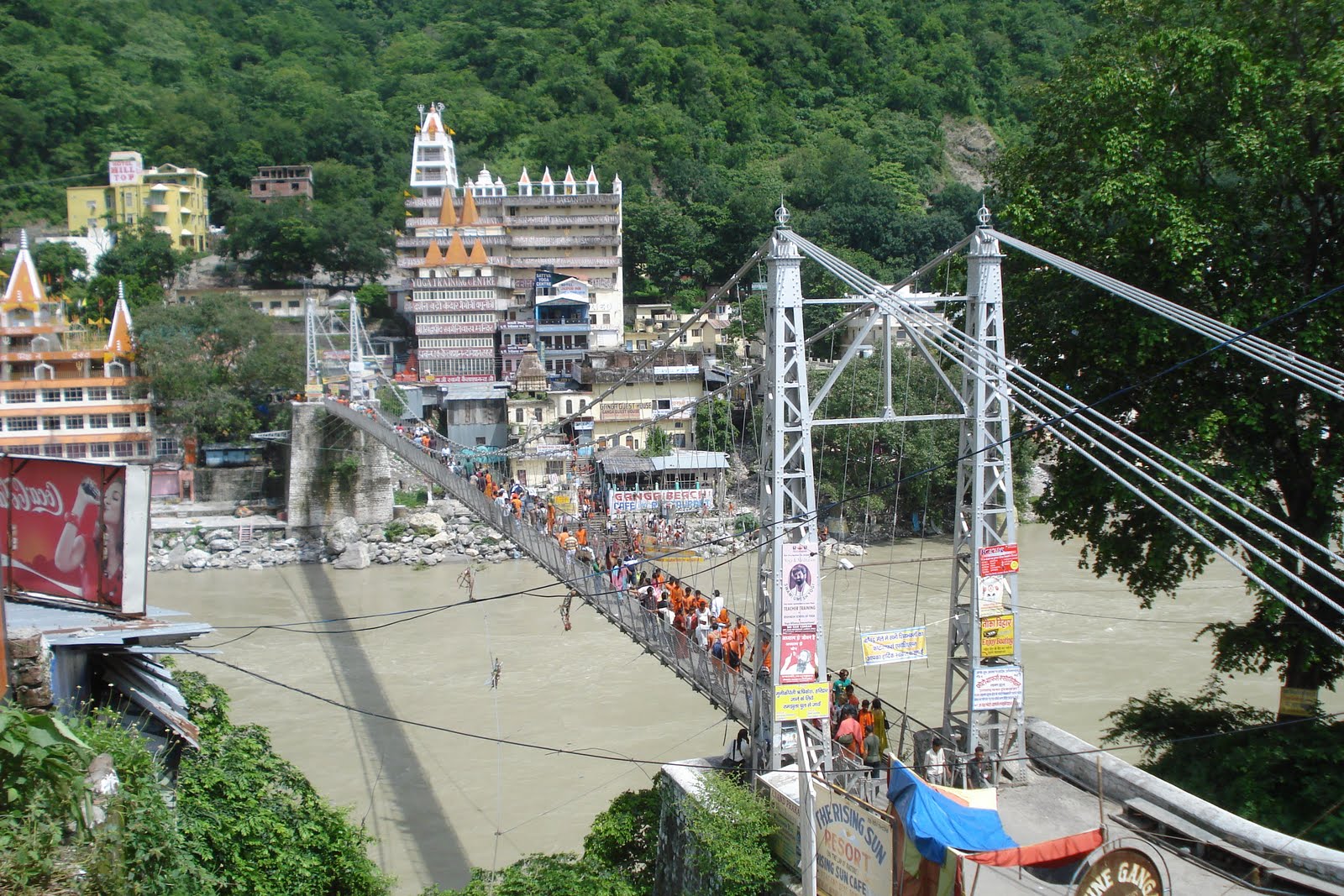
One of the most prominent features of Rishikesh is the huge suspension bridge that spans the entire breadth of the Ganges river. Whenever you see pictures of Rishikesh you will see pictures of the bridge. This bridge is about the width of your average sidewalk. Yet you will have four of five or ten people trying to walk in the same space, and believe it or not while walking across the bridge myself, a motorcycle went right past me.

The entire month of July is the pilgrimage month and the holy pilgrimage color is orange. It has something to do with the color of the sunset and how the color symbolizes the going down into the river and then coming up as a newly washed person.
Just as the color of the sky when the sun is setting and rising. So many people were bathing it was extremely crowded. A lot of people have a lot that they need to cleanse in the their soul. I am not sure they find what they are looking for though. The Hindu scriptures say nothing of absolution. Each of these people will come back and do the same thing next year with no sense of certainty that they are getting what they came here for.

Thursday, August 4, 2011

AJAY

His story begins something like this. Ajay was brought up in a Brahmin family. He was high caste. His family was poor but they knew they were set up well for their next life. Ajay, when he was just five or six years old heard about someone named Jesus whom he had never heard of before. What he heard about Jesus sent him on a long journey of discovery. One problem though; being from a high caste family few people were reluctant to share with him because of the potential consequences. Ajay had several friends over the years who knew about Jesus but not enough to satisfy his curiosity.
Ajay's two kids Appu (boy in blue) Kushi (girl in pink and white) and sister-in-law Kami in the dark blue.

In his early teen years, his mother became very ill. Ajay remembered a story from the Bible where Jesus had prayed for forty days. So Ajay committed to pray for forty days for his mother's recovery. On the fortieth day he went to his mother and asked how she felt. Turns out she felt good. They went to the doctors for a check up and there was no sign of the illness. Some time later, his father became ill, and again he prayed. The Doctors told his father he was dealing with kidney failure and did not have much chance to live more than 35 days. Again after Ajay prayed his father was healed and went on to live a very productive life.

At this point Ajay would say that Jesus was the god for him. As a Brahmin, they were very devoted to the Hindu form of worship. Many people pray to many gods. Jesus seemed to be the god who answered his prayer so Jesus was his god. Several years went by and Ajay continued his search for more understanding of who Jesus is at this point Ajay himself got very sick. It was the same sickness his father had. Ajay developed Jaundice, he had to quit his job and return home. His parents were so poor that there was one point where all they had for sustenance was the water that was left over from cooking rice at his uncle's restaurant.
Ajay and his family. On the left in blue is his wife's sister, next to him his wife, and his two kids are in front. It is uncommon for a family to take care of the wife's family if there is a need. Usually the familial connection is to the husbands family. So inviting his sister-in-law into the home to provide her with an education is uncharacteristic of a Hindu, but very characteristic of a Christian.

Ajay had been so sick for so long that once again he turned to his god, Jesus and prayed for healing. The night he prayed, he had a dream. In the dream he was slapping Jesus in the face. Time after time right hand then left hand. Then he noticed a tear in Jesus’ eye. He stopped and asked Jesus why he was crying. Jesus said, you always come to me and ask me to bring healing. Ajay replied, “yes you are my god, you are the one for me you act when I pray so of course I pray to you.” Jesus said, “But, you only come to me when you need something, you also honor other gods. I want to be the only God for you. So while still dreaming Ajay figured he was going to die anyways so he might as well tell Jesus that he would live for him only until he died. Jesus accepted his word and when Ajay woke up in the morning he was completely healed.

What is so uncommon about Ajay's story is that it is not uncommon. Stories like this are actually quite common. Miraculous healings and visions of Jesus are thought of as normal by most of the people I have talked to over these last weeks. Why is it we do not experience these sorts of things in America, or hear them from Americans???

Saturday, July 30, 2011

BHAGWANPUR

I went to another school in a town called Bhagwanpur. This is a very overcrowded school now and it has a short but impressive history. It started as just a three room school not too far from its current location with just twenty three students. Two rooms were classrooms and one was an office for the teachers. After just three years the school became packed with just over 60 students crammed into their two small rooms. With an increasing demand to take more students they needed to find a new facility.

Their current building became available to rent and so they took the opportunity to move into the
new location which had ten or twelve rooms that could be used as class rooms as well as a few offices. The school currently is running around 500 students form K through 8th grade. Their current class size is about forty to fifty students per class.

The Indian people value education so much so that if there is a chance their student can attend classes in a non-government school they do anything they can to get their kids in. It just so happens that the schools that are run by Christian organizations have the best reputation
for education so they are the most sought after schools. This one is so full that they are in need of moving again and they have only been in existence for six years.

They have purchased a plot of land that is about two acres in total. The plan is to build something similar to what was built in Pathrie. A large three story complex with classrooms and some offices. And then build some housing for teachers and administrators as well.

One thing that set this school apart from Pathrie however is that this school also has an orphanage as part of the ministry to the community. They only have room for 30 kids. They actually call it a children's home. Each group of six to ten kids has an adult couple that cares for them. The idea is that each couple acts like parents to these kids and each kid is like a sibling to the other in their "family". They try to create some semblance of a family for these little ones.

I walked into one of the rooms while the kids were in class as part of a tour I was getting of the facilities and started crying. (No one else was around me). I don't know who the kids are who slept in that room, I don't know their stories, I could not point them out in a crowd, or if they were standing in front of me, but I cried for them. No child should ever be thrown away. What does it do to a child and later on as an adult to know that some one cared just enough to not abort them but not enough to care for them personally. I know that this is not the case for many of the students but it for some. I have personally heard enough stories to imagine what some of the stories in this room might be like.

This is the land that was purchased for the new facility. It is a field today, but hopefully in another year or two they will have the money to build at least the first floor of their dream.

I walked out of the building not wanting to leave. I really wanted to see the kids when they got out of school and give them a hug, and tell them that even if no one else loved them, that Jesus loved them. But I the reality is that two minutes with me is not going to change things for them. It might make me feel better, but it does nothing for them. The heroes here are the couples who have dedicated themselves to bringing up kids who are not theirs to understand the love of God.
This is one of the bedrooms at the Children's home. It is right next to the school. You notice their beds are neatly made and on one of the beds, (it is hard to tell) there is a Bible sitting there. These kids have very few if any personal possessions. To have your own book is a big deal especially if it is a Bible.

No one else in their society is concerned about showing them this kind of love. Not even their own family members. At least the Muslims will care for extended family when they are in need; even the Sikhs, a Hindu reform group which started about 600 years ago will care for extended family who have fallen on hard times. But if you are a Hindu and you fall on hard times it is because you deserve it. And children sometimes pay a high price for this. I am so thankful for the people in these schools and homes who are dedicated to the next generation of Indians.

I don't remember his name, even if I did, I would not be able to pronounce it or spell it, but this man is a teacher in the school and he is one of the house parents as well. He and his wife have two kids, plus the children in the home. I don't know his name but he is a hero to me.

Wednesday, July 27, 2011

PATHRIE

On Sunday afternoon I traveled to a town called Pathrie. Actually we were just outside a small farming community which was just outside of Pathrie. The village is very poor, made up mostly of farmers.

The grounds owned by the school taken from the roof. The center of the picture is the faculty housing building. In the lower right you can see a couple hundred bikes which the kids ride to get to school.


It was a predominantly Muslim area until about twenty years ago or so. The government needed to supply more electricity to the area and so they planned to build a hydro electric plant on a river some twenty kilometers away. The result however was that many villagers from that area would be flooded out of their communities.

Students stand in rows every morning for their morning routine, which includes the pledge of allegiance, singing the national anthem, and reciting
the Lord's prayer.

The government informed the people of their plans and told them that they were providing a space for them to move to and resettle. That area just happened to be right outside of Pathrie near this already existing Muslim community.

A student stands and reads during class time.

What resulted was a growing tension between the two communities. The Muslims had their own established community for years and years, and they did not appreciate being imposed on by the government. To them the Hindu’s are unclean (spiritually speaking). Fast forward about eighteen years, and this Christian school gets its start literally between the boundary lines of these two communities. The boundary line actually consists of Sugar Cane fields and wheat fields.

This was the first class in which I sang a song. I was drawing a blank with the guitar in my hand and ended up sing "Amazing Grace" / "Grace like Rain"

Classes for the school begin at 7:40am and conclude at 1pm. At that time the students are dismissed and the teachers get a break. A few of them live on the School grounds in housing that was built for faculty and staff. At 4pm an afternoon program begins which goes until 6pm. This program is sponsored by Compassion International.

At the end of a long day here the Compassion sponsored students get some food in the evening

Each of the students who attend this program do not have the money to attend the school so instead they attend the government schools. However the government school do not really provide much of an education. Each student progress from one grade to the next regardless of performance, and the class sizes are as small as 30 to 40 all the way up to as many as 80 per class. Sometimes the teachers don’t show up. Needless to say it is not an environment that is geared towards learning and education.

The school here actually has a class on personal heighten. It is an attempt to educate the younger generation on how to maintain clean living. Here a teacher inspects a students "First Aid" kit as part of their curriculum.

The after school program is designed to be a time of tutoring and helping with homework, and since these are the poorest of the poor they also get a meal as part of the sponsorship. Most of my time there the kids just wanted to hear about America, so I talked with them about what America was like. Some found out they I play guitar so I played and sang for all the classes I visited after word got out. I visited the little kids the next day and could not avoid singing and playing for them either. A lot of kids wanted my name and email address, I relented. The real story though is the principal and the assistant principal. Their dedication to the work here is commendable. They have seen this place go from Sugar Cane field to a one and a half level school.

Work progresses slowly on the building project where they are adding a second floor. This structure was designed to be a three story school. Though they have to take it a stage at a time as the get the funding.

Soon it will be a complete two level school. They have worked hard to make the School in Pathrie what it is and just as hard to maintain a solid reputation in the community. Along with that Matt and I stayed in Ajay’s home (the assistant principal).

Ajay, the assistant principal, and his family.

When we arrived they showed us to the guest room. It was small and the bed was basically a low table with blankets on it. It was not until the second morning when I got up a little early and happened to see the kids room and I saw Ajay sleeping on a blanket on the floor that I realized he and his wife gave us their bed, and they were sleeping on the floor in their kids’ room. These are the kind of people I stayed with. I will write a short post on Ajay later…